Viser innlegg med etiketten SOCIETY. Vis alle innlegg

torsdag 17. mars 2011

clean city


The Senate of the State of Kansas in the USA intensifies the fight against what they believe is a common decline in the morality in the society due to the porn industry and everything that goes with it. A new law requires that strip clubs, porn cinemas, shops selling sex toys and the like, is not be established closer than 300 meters from schools, churches, parks, nurseries and libraries. This is a pretty absurd problem, 300 meters is a relatively large distance in a city and how does this affect a churchgoer if he must pass a pussypump store on his way to the sermon? Is it really so that the presence of sex in the city is considered so dangerous it must be banned? At Grønland churches, mosques, nurseries and pornshops coexists, side by side, not much controversy, and, oh, since so much funstuff is already banned in Norway, its a big black market due to supply & demand, does it become better if we pretend it does not excist?

lørdag 12. mars 2011

every city got a beat


With over 50% of the population beeing catagorized as immigrants, Grønland is a truly heterogenous place. Every country and city in the world has its own pace and beat and the speed of walking is correlated to this pace. What happens when people from so many different places meet up and construct new societies, does the pace change the rhythm of the city or its users? My first impression is that Grønland has a slower walking pace than the rest of the city, the so-called flaneur is alive in this area; walking as an act of socializing seems to be cherised by the people here and the interaction and sudden encounter it creates is embraced. The urban wanderer with his aimless strolling may be looked upon as a means of reclaiming the streets for the pedestrian.
A study done by psychologist Richard Wiseman shows the difference in walking speed across the globe. People from 32 countries were timed walking over an 18 metre stretch of un-crowded pavement, resulting in these numbers;

1) Singapore (Singapore); 10.55
2) Copenhagen (Denmark); 10.82
3) Madrid (Spain); 10.89
4) Guangzhou (China): 10.94
5) Dublin (Ireland); 11.03
6) Curitiba (Brazil); 11.13
7) Berlin (Germany); 11.16
8) New York (United States of America); 12.00
9) Utrecht (Netherlands); 12.04
10) Vienna (Austria); 12.06
11) Warsaw (Poland); 12.07
12) London (United Kingdom); 12.17
13) Zagreb (Croatia); 12.20
14) Prague (Czech Republic); 12.35
15) Wellington (New Zealand); 12.62
16) Paris (France); 12.65
17) Stockholm (Sweden); 12.75
18) Ljubljana (Slovenia); 12.76
19) Tokyo (Japan); 12.83
20) Ottawa (Canada); 13.72
21) Harare (Zimbabwe); 13.92
22) Sofia (Bulgaria); 13.96
23) Taipei (Taiwan): 14.00
24) Cairo (Egypt); 14.18
25) Sana'a (Yemen); 14.29
26) Bucharest (Romania); 14.36
27) Dubai (United Arab Emirates); 14.64
28) Damascus (Syria); 14.94
29) Amman (Jordan); 15.95
30) Bern (Switzerland); 17.37
31) Manama (Bahrain); 17.69
32) Blantyre (Malawi); 31.60

torsdag 3. mars 2011

The city of darkness


An area 200 metres by 100 metres of solid building, 35.000 inhabitants, a population density of approximately 1,255,000/km2, this was the facts in Kowloon- The Walled City- certainly one of the densest urban slums in the world. Situated in "no-mans land", from 1945-1993, a political loophole created a zone of Hong Kong where there was no law, and wheres there no law- theres no police. The resulting anarchic monolith was the the closest thing to a truly self-regulating, self-sufficient, self-determining modern city that has ever been built, infrastructure was taken care of in theire own way by drilling wells and tapping into nearby city’s water sources, the same with the necessary electricity, since no sunlight passed through the streets were lit by fluorescent lights, creating a dark damp underworld.
With no regulations of any kind, this was the place the triads came to hide, the illegal businesses of Hong Kong happened here and, like all hideaways it attracts the usual types drawn to undiscovered countries: criminals, dreamers, dissidents, refugees and the plain desperate. But, at the same time this was a well functioning autonomus society, kids were brought up there, people got married there- lives were lived. After the triads gave up the controll of the city in the 70s, the city became self governed. Some consider this society to be the rarest of things, a working model of an anarchist society, while others, in theire conformity describes it as aliving shithole. The true fact is; it was less crime there than in the rest of Hong Kong. (maybe because people dont shit were they eat.) Nonetheless, it fascinating to look at the citys structure, it becomes a monolith, the buildings rising up to 14 storys, morph into each other, the streets disappear in tunnels, no lights gets through, not even Jodorowski could have imagined a city as dense and at the same time as scattered as this..

onsdag 2. mars 2011

an unfamiliar sound


A couple of years ago, the Swiss population determined, by election, to ban the building of minarets on mosques. This decision is highly controversial, meaning that the majority in this case will decide on a minority's right to express both their religion and their cultural heritage through a building design and denying them the right to express themselves in their shared, common public space. Is this a decision which occurs because of irritation over a change of the street space aesthetics or is it racism - different rules for different subcultures in society?
One of the most elaborate new buildings in Grønland is the Islamic Cultural Center Mosque in Åkebergveien.
In 2000, the mosque applied to get the right to call to prayer from loudspeakers outside the mosque. It was met with fierce protests, and it was even formed an action group against prayer. The end of the story was that they were allowed to pray in the framework of 60 decibels. Nevertheless, the mosque chose not to avail themselves of this opportunity and only prayer inside, probably to avoid confrontation (but they probably wouldnt had applied if it wasnt a wish...) At Grønland the senses have a stronger presence than elsewhere in the city. Here the scents are stronger, the colors more present and the sounds more intense than in the rest of the city. These are variables that help to stimulate the curiosity and differentiate streets from each other, these are little hints that tell about what happens but that might not be seen but nevertheless gives a broader expireience of the situation.
It is through these sensory experiences we can experience the city in its entirety, the perceptional account for only a small part of the overall experience, we must not forget the rest of the senses in our understanding of the city.

lørdag 5. februar 2011

exploited privacy


a link to a site posting screenshots from google earth/streetview, a glimpse into how certain individuals somewhere in the world choose to act on a certain given time. Even though sites like this enables us to get an impression of what reality looks like through lenses like this its still just that; an impression.

torsdag 3. februar 2011

solitary city


To play a solitary game of city is the equivalent of beeing alone in a city, in a place designed for beeing amongst others its regarded as lonesome to stay all by yourself, one is the loneliest number you can find some people say. The household statics in Oslo disagree with this conclusion; every fourth household in Norway consists of only one person. In Oslo, the proportion of the population over 16 who live alone is a total of 52 percent, or 150 000. Of these, 75 percent are women.

We find half of those living alone among the quarter of the population with the lowest incomes. Especially young people living alone are overrepresented in the low-income group. When students are excluded from this group( you know- we who seek knowledge must pay a high price for this; we don’t even deserve to be included in the group; “poor”…), the proportion of "poor" among citizens under 30 years who live alone is four times as high as the average of the population.

Housing costs for people living alone has increased by 40 percent since 1987, but the costs have only risen by 16 percent for others. The proportion of people living alone who own their own homes has also declined over the past 15 years.

In sum, living alone in Oslo means higher living costs per person than the average. Living alone in Oslo has a total consumption expenditure, which is 40 percent higher than people living alone outside the major cities.
You gotta pay the cost to be the boss/ its expensive to be the king in the castle.

mandag 31. januar 2011

Enough is never enough..


Approximetly two years ago, chief of police; Arnstein Gjengedal promised the public to keep the streets of Grønland drug free, or as he stated; Enough is Enough! Like all other daring statements its a failure, or as I stated myself on this blog half a year ago; a user is a user 365,24/7. In a city there will allways be secret transactions and secret locations for doing illegal bizz, the only thing we can change about this is the way we regard this, if we chase these people away from a known locality theyll just find a new place for theire activities tomorrow. Whats bugging me about this is not the dealing of illegal substances, nor the appearence of the buyers/ users but, the media plays a big role in portraying the reallity of a neighbourhood; the constant focus on the problems instead of having a discussion around solutions. This link is from yesterdays aftenposten and is about the war on drugs at Grønland. Last year 737 persons where comprehended, half of them more than once. One out of two has either been rejected as an asylant or is living here without proper permit. 136 of them is enrolled as asylants, and for the rest, the story goes on…
According to the police; people from Algeria, Nigeria and Somalia are in the top three ranking of the arrests, these three countries are among the worst on the UNs list of Living Conditions (Somalia is not even on the list due to lack of data..).
Last year, the police expelled 189 of the arrested people in this neighbourhood back to theire country of origin. The questions that should arise then is not if these people are criminals or not, (of course they are when they have broken the laws), but what we should question is rather WHY they are there, on the streets, pushing dope under the bridge. There is a reason for everything but whats the reason for the constant witchhunt on the users and buyers and the will that some journalists have in making Grønland appear more dangerous than it really is? I know that rain sells better than sunshine, lets not hope that this also accounts for stigmatization…

torsdag 20. mai 2010

sleeping places


In a cityscape, the secret getaways becomes important, this is the places where the "non-people" sleep, eat and live theire lives, under the bridge, in an abandoned building, between the roads and under the trees. Seeked out a few of these places and checked out the living conditions for these unwanted members of society...

Shifting Appearance


In connection with the celebration of 17.th of may, the whole of the Vaterland Parc went from beeing a drugspot to become an explosion of vivid colours, sounds, movements and joy. The tivoli came to town, an example of intervention through activity, presence and new buildings added to the site, introduction of a new program that totally changed the area. When the tivoli left two days later, the disorder re-established itself and everything went back to normal, the junkies found their old spot, the sellers theire costumers, the beggars theire patrons etc...

mandag 10. mai 2010

MAPPING VISUAL ADD-ONS


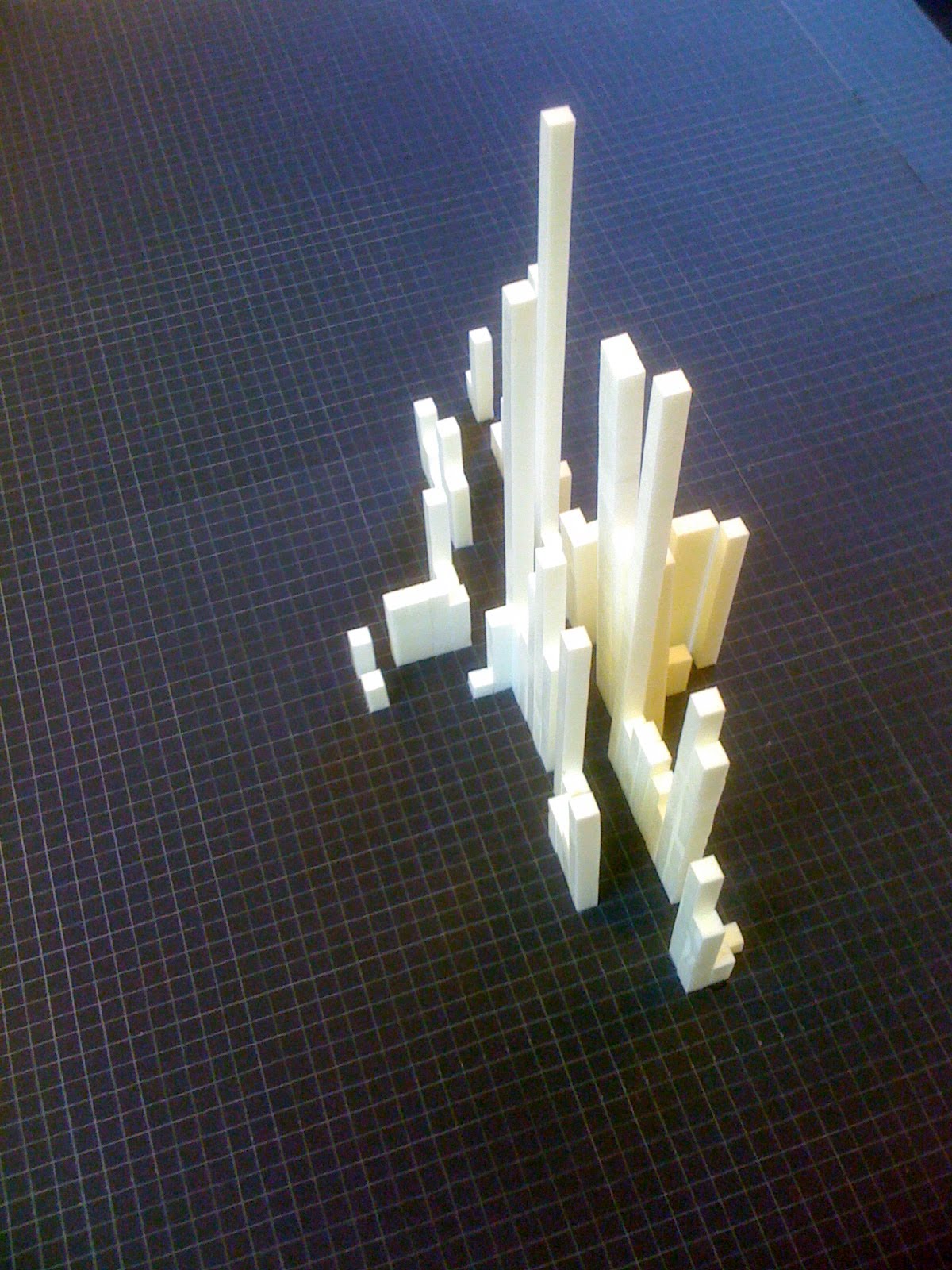
Started a new way to map the visual add-ons to the buildings in the area. Is there a connection between visuall add-ons (commercial signs, roadsigns, graffiti etc..) and tempo, temporality, action, etc...
A grid 1x1 cm is put on top of the 1:1000 map, each facade is thouroughly examined. The first column makes up the shopowners/buildingowners add-ons to the existing facade. This is put up in order to gain attention and costumers, the rule seems to be that the one that screams highest gets the cash. The actual number of signs makes up the hight of the column, one cm pr. sign. Secondly, the column shows the number of "official signs, i.e. the ones that shows important information regarding the actual use of the area, the rules etc., this is another layer of information and is put up with no other aim than to secure a well-functioning society/infrastructure. The third column on top shows the actual number of tags/graffiti on the building facades. These are made by people that seemingly has no right to the facade, its an individuals intervention on private owned buildings and this defragmentizes the boundaries between public/private. This is also connected to the broken window theories, can I through an abstract presentation of this data see more clues to how this relates to our interpretation of the cityscape?

torsdag 6. mai 2010

OPEN/CLOSED


Oslo Prison is the biggest prison in Norway with 392 prisoners and 367 employees.
The prison opened its gates for its guests in 1844 and is built accordingly to the "Philadelphia System" which meant that the prisoners were isolated in solitary confinement. Nowadays this has changed dramatically and the system now operates with a totally different approach; "There is a greater tendency to keep prisons open [to the public] so that people can see inmates as human beings they can identify with," says Nils Christie, professor of criminology from the University of Oslo. Nowadays the government emphasize on seeing prisons as part of normal society and the need for reintegration into society rather than the need for punishment.
With such a massive building in such a central place, and the fact that out of Grønlands population wich makes up 7788 inhabitants, the inmates makes up around 5% of the total population (not sure if they are included in the counts or not, but, they are allowed to vote and they do live and have their adress there...) Every once in a while the prison opens its doors for the public- so called open prison days- and try with events like this to be a part of the neighbourhood. The prison is seperated from the area with a huge wall, even though the distance seems short the gap is long. In front of the prison is the most public area of Grønland and the only open recreational area, the park where people sunbathe and have barbeques in the summertime. This makes an interesting juxtaposition between the closed and the open.
The Guardian-article about political prison debate
Oslo Kretsfengsel

tirsdag 4. mai 2010

BANGSMASH


Friction is the "evil" of all motion. No matter which direction something moves in, friction pulls it the other way. Move something left, friction pulls right. Move something up, friction pulls down.
In Europe, uprisings, riots and tense situations are quite common and is somewhat regarded as a natural way to protest. In our neighbouring countries, Sweden and Denmark, riots in so-called immigrant areas happens all the time, its a matter of letting the government know that they exist and will not tolerate the neglect of their presence. This is not the case in Oslo, the tensions are not existing in the same way, is this because its nothing to complain about or is the norwegian society so frictionless that it simply turns people from beeing active participants into passive observants.
I quote from my newlyfound favourite group on facebook;"Det er om å gjøre å være bevisst antirasist og si det til seg selv hver dag."
Nice thought but, if you get mad, why not be mad?

mandag 3. mai 2010

criminal city


Local knowledge is the most important feature for a criminal use of a city. In order to get in, do the job job and dissapear, the criminal must leverage their knowledge of their environment for their own protection. How to get through a building without using doors? How to use different parts of the cityscape as camoflage and protection, find out about the city´s weakness in order to avoid detection? One way is to hide, another is to cause a diversion/distraction.

søndag 2. mai 2010

property


The discussions around property are one of the most ambivalent in todays media.
Throughout history, mankind have used property as a hierarchical tool in controll of the masses-this is mine-not yours, stay in your place etc..
Traditional principles of property rights include:

1. control of the use of the property.
2. the right to any benefit from the property.
3. a right to transfer or sell the property.
4. a right to exclude others from the property.

Traditional property rights do not include:

1. uses that unreasonably interfere with the property rights of another private party.
2. uses that unreasonably interfere with public property rights, including uses that interfere with public health, safety, peace or convenience
Property
Intellectual Property

With the technology of today the discussion is quite different, once something is digitalized it doesnt make sense to claim proprietary ownership of it-IT´S A COPY.
In the FLOSS system, it is a given fact that property is theft, you can only own the background content, i.e. the code, not the "final" product because this is everchanging, the traditional order and the barrier between product and byproduct is torn down.
In order to allow for invention, the traditional claim of the property must be revitalized, like a remixed tune, the "thief" becomes the developer.
How to deal with this in a city where the boundaries between yours and mine are the glue that holds the society together, that differentiates people and make them care for their surroundings. Are there any clues on the street, the interaction, that can inform us of another way of thinking? At Grønland, the idea of a controlled ownership seems to be less abundant than in the rest of the city, could this be because of the tempo, the compactness of people on the street and in the fact that people are more tolerant, the ephemerality is more visible, are the facades of the buildings and the air in this part of town more public here because of this? It seems at least that the traditional property view is less of an issue here than other places.

lørdag 1. mai 2010

HOW MANY THOUGHTS?


Some years ago, the National Science Foundation made some statics about how many thoughts per day an acverage person has. The results vary a whole lot, depending on work, background, culture etc… We think 1000 thoughts per hour. When we write, we think 2500 thoughts in an hour. The average person thinks about twelve thousand thoughts per day. A deeper thinker, according to this report, puts forth fifty thousand thoughts daily. Reading other statics give us approximitly the same answers, the human brain thinks on average from 12.000-50.000 different thoughts each day.
Its also viable to think that the rate of thoughts has increased over the last century and this is due to the fact that life is getting more complex, daily routines more tight, and information needs to be processed much quicker. Another fact is the constant bombardment of the information that surrounds us, the new media hype. However, there seems to be few resources to support this, or discuss other possibilities. It seems that the thoughts are constant, the shift is only in the focus.

Attention/Distraction


Observing a couple chatting at a cafe; every fifth minute or so, one of them constantly shift attention between the conversation and his cell phone. When one talks, its normal to glance away to look at the surroundings or other people every once in a while, but whats different now is the shift in attention, from a virtual conversation to a actual mode of presence. In how many places can we be at the same time? What happens when we have multiple attention points, dealing with more conversations at the same time, using different mediums to conversate? The intimacy of a conversation does not any longer require people to be next to one another. How to prepare for this multilayered communication?

torsdag 29. april 2010

POWER STRUCTURE


Two of the most feared public buildings in the city are located at Grønland. The Prison of Oslo and the Police Headquarters, in the first you end up if you fuck up, in the latter you end up if you fuck up a little. (Prison vs. Arrest.) They are out of touch with the sphere they coexist with, the scale is to big and they create a distance to the rest of the area, becoming isolated islands of power. The authorities will allways have this need of showing off the structures of power, but, in this case the distance tend to get a litle bit too much.
What are the implications regarding the governments negative charachter, when the authorities distance itself so strongly from the rest of the neighbourhood? The amount of money spent on police increases each year, the proximity wich comes with police foot-patrols gets decreased each year. Result; the broken window theory, mistrust towards the power, mistrust towards the ones that are their to secure equal right to society.

onsdag 28. april 2010

THERES A JUNKIE IN EVERY TOWN


the stash of hash...
Mr. Harry Jones...
need for speed...
the thrill of the pill...


After working at Grønland at a bar for quite some time I have made some interesting encounters with strangers, people I really dont wanna be friends with but at the same time needed to hook up with in order to see ”the secret societies”.

Last monday I hooked up with ”Mike”, a local heroin dealer, pushing at street level.
Mike is an infamous character working at Vaterland, one of the main spots for the heroin trade in Oslo.
Mike wanted to show me how the drugtrade worked and agreed to help me score some dope. Within the short period of an hour we bought heroin, amphetamine, funky blue pills and some hash. Due to implications on the criminal consequences, Mike was bying the dope while I was witnessing.
It was an interesting experience, now I got the first hand information I need in order to map this part of the chaos. Prices do vary, for a user dose of heroin the price was 250, amphetamine set us back a 100, the pills were 20 each and the hash was 100 a gram. The hard drugs was bought at Vaterland from a white dealer, while the hash was bought from illegal african immigrants innside the metrostation at Grønland.
Later we tried to score some khat but the somalies dealing the drug Grønlandstorget was suspicious towards non-somalians bying the drug, so the idea of bying this got abolished. I left ”Mike” with the drugs for him to enjoy alone, heading back to Bergen. Will hook up with him again and talk more about the trade, the the dealers and the customers when I return to Oslo for the second part of the analysis.
Even though the police do their best to stop this and interupte this type of affairs it was extremely easy to get the stash we wanted. A junkie is a junkie 365-24/7 so the business is never closed.
No matter what you think of drugs, I like the idea of a selfsustainable economy operating within its own context and by its own complex system.
NIVAs surveys from the water treatment plants in Oslo in 2007 indicates 15 cocaine doses per 1000 inhabitants per day. This gives us 8700 doses of cocaine in Oslo snorted up the nose every day. Cocaine addicts stand out from the users of heroin and amphetamines due to the fact that they often only use the stuff in the context of a party (some party everyday…). For the users of heroin the party is definitely over. It is estimated that between 8,200 and 12,500 inhabitants in Oslo is addicted to heroin and amphetamine and their injection of the drugs is extremely harmful to health.
An average user of heroin need on average 760 NOK a day to meet their as an amphetamine user can operate on 290 NOK. (Figures from SIRUS 2004)
- We are at Grønland metro station daily and arrest people. Steadily. Every day, all year round, 365 days a year, we arrest ten people in our circle of drug crime, "says Stølen, chief of police at Grønland Police Station.

OpenGraph


Facebook’s Open Graph initiative could conceivably create an Internet where digital music services will know each user’s musical preferences the minute they navigate to their site, and automatically cue up the playlists, recommendations and music geared toward them without going through today’s painful process of “teaching” the service to recognize their tastes. That’s because Open Graph is designed to track those tastes on every other site users are on. With Open Graph, Site A learns from the activity on Site B. That’s what’s missing today on the Internet and that’s what Open Graph is trying to provide. If we disregard the problematics concerning ones privacy and how the developers and owners of sites like this misuse this information to get more cash we see the beginning of a new form of recognition, a responsive system that changes accordingly to your taste and thus reinvents oneself.

mandag 26. april 2010

A DIFFERENT REALITY


People tend to get so caught up in their own sphere of reality that a different form of logic can really freak us out. The Japanese addressing system is used to identify a specific location in Japan. In Japanese, addresses are written using the opposite convention from Western addresses, starting with the biggest geographical entities down to the more specific ones. They have developed a hierarchical structure, zooming in on the right building. They start wide, then zoom into the exact location step by step. In Tokyo, streets dont have names. Blocks are numbers, streets are just the empty space in-between blocks. The buildings inside the block are numbered in order of age, the first building built there is #1. The second is #2, even if it's on the opposite side and so on. Nowadays we have developed new tools to identify streets, buildings and blocks. I could if I liked to do so, adress my front door by its latitude/longitude and people could simply find it by using their mobilephone and its GPS device. What Im thinking of is this different reality, every system works as long as people understands how to read them.