Viser innlegg med etiketten INFORMATION. Vis alle innlegg

mandag 7. mars 2011

hidden


One of the reasons we underestimate the sheer physical mass of our power and information networks is that they're hidden from view.

torsdag 3. februar 2011

solitary city


To play a solitary game of city is the equivalent of beeing alone in a city, in a place designed for beeing amongst others its regarded as lonesome to stay all by yourself, one is the loneliest number you can find some people say. The household statics in Oslo disagree with this conclusion; every fourth household in Norway consists of only one person. In Oslo, the proportion of the population over 16 who live alone is a total of 52 percent, or 150 000. Of these, 75 percent are women.

We find half of those living alone among the quarter of the population with the lowest incomes. Especially young people living alone are overrepresented in the low-income group. When students are excluded from this group( you know- we who seek knowledge must pay a high price for this; we don’t even deserve to be included in the group; “poor”…), the proportion of "poor" among citizens under 30 years who live alone is four times as high as the average of the population.

Housing costs for people living alone has increased by 40 percent since 1987, but the costs have only risen by 16 percent for others. The proportion of people living alone who own their own homes has also declined over the past 15 years.

In sum, living alone in Oslo means higher living costs per person than the average. Living alone in Oslo has a total consumption expenditure, which is 40 percent higher than people living alone outside the major cities.
You gotta pay the cost to be the boss/ its expensive to be the king in the castle.

mandag 10. mai 2010

MAPPING VISUAL ADD-ONS


Started a new way to map the visual add-ons to the buildings in the area. Is there a connection between visuall add-ons (commercial signs, roadsigns, graffiti etc..) and tempo, temporality, action, etc...
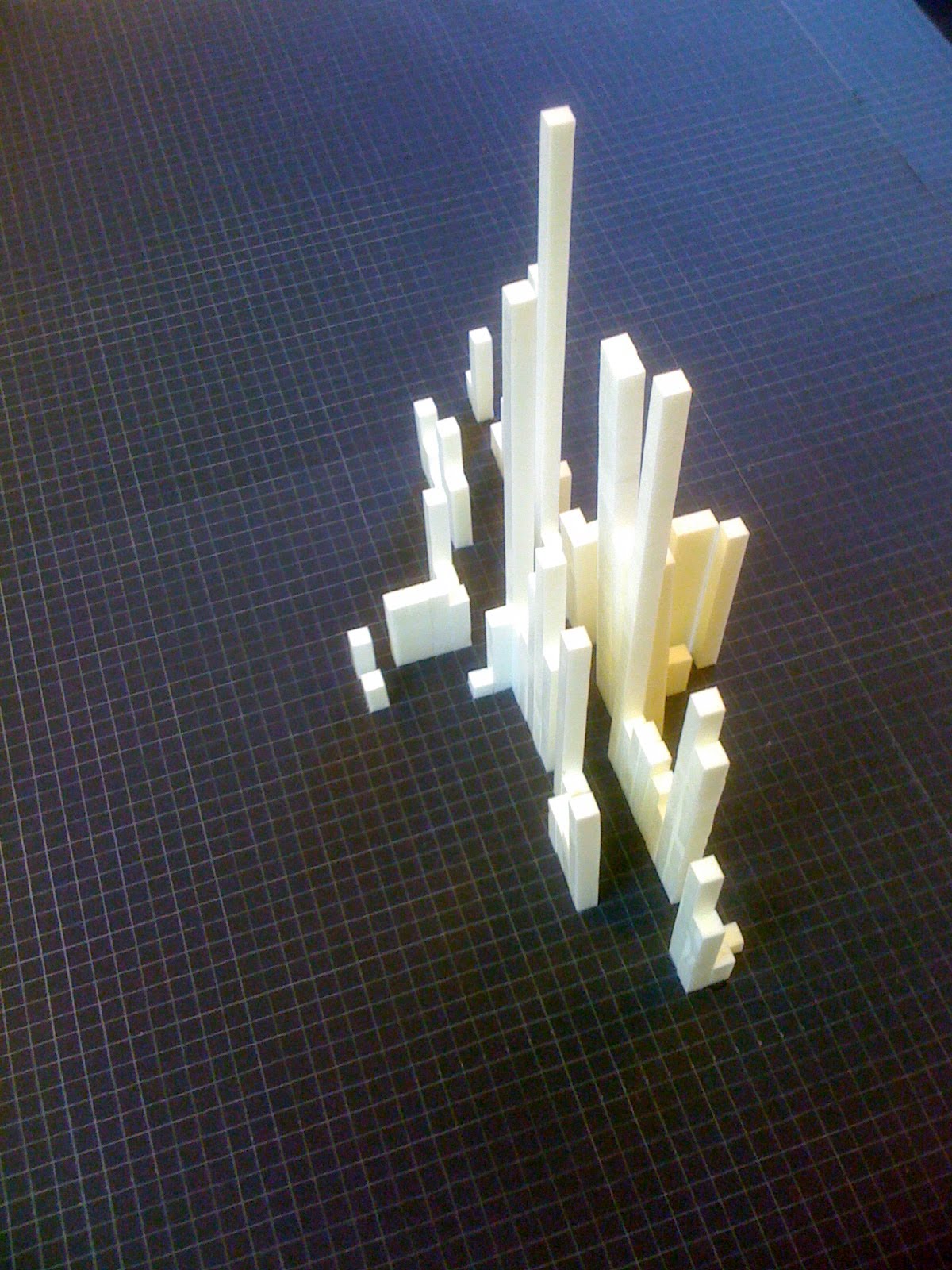
A grid 1x1 cm is put on top of the 1:1000 map, each facade is thouroughly examined. The first column makes up the shopowners/buildingowners add-ons to the existing facade. This is put up in order to gain attention and costumers, the rule seems to be that the one that screams highest gets the cash. The actual number of signs makes up the hight of the column, one cm pr. sign. Secondly, the column shows the number of "official signs, i.e. the ones that shows important information regarding the actual use of the area, the rules etc., this is another layer of information and is put up with no other aim than to secure a well-functioning society/infrastructure. The third column on top shows the actual number of tags/graffiti on the building facades. These are made by people that seemingly has no right to the facade, its an individuals intervention on private owned buildings and this defragmentizes the boundaries between public/private. This is also connected to the broken window theories, can I through an abstract presentation of this data see more clues to how this relates to our interpretation of the cityscape?

søndag 2. mai 2010

The Place Where We Bury The Lie


A library is said to be the archive of the common knowledge in society, the place where we stack up the the thoughts we want to secure for the aftermath.
It´s estimated that the worlds great libraries are doubling in size every 14 years, a rate of 14000 percent each century. Before the big fire in the library in Alexandria in year 30 AD, it contained 40000 books. In the early 1300s, the Sorbonne Library in Paris contained only 1338 books and yet was thought to be the largest library in Europe.
Today there are several libraries in the world with an inventory of well over 8 million books each.
The largest library in the world is the U.S. Library of Congress in Washington, D.C.
The British Library, the world's other great library, houses a collection comprising of 150 million items as against the 130 million housed by the Library of Congress.
However in terms of shelf space the Library of Congress shelves occupy a space of about 850 km while the British Library shelf space is 625 km long. The Library of Congress' collection of books is in the range of 29 million while the number of books of the British Library is about 25 million.
What we collect, archivate, and pass on is never the truth, its allways a subjective act.
Is the library just another place where we bury the lie?

lørdag 1. mai 2010

ZOOMaSHROOM


mapping the intricacy on Grønland at the moment. The more I seek, the more ill find, whats relevant, whats not, is it all?

HOW MANY THOUGHTS?


Some years ago, the National Science Foundation made some statics about how many thoughts per day an acverage person has. The results vary a whole lot, depending on work, background, culture etc… We think 1000 thoughts per hour. When we write, we think 2500 thoughts in an hour. The average person thinks about twelve thousand thoughts per day. A deeper thinker, according to this report, puts forth fifty thousand thoughts daily. Reading other statics give us approximitly the same answers, the human brain thinks on average from 12.000-50.000 different thoughts each day.
Its also viable to think that the rate of thoughts has increased over the last century and this is due to the fact that life is getting more complex, daily routines more tight, and information needs to be processed much quicker. Another fact is the constant bombardment of the information that surrounds us, the new media hype. However, there seems to be few resources to support this, or discuss other possibilities. It seems that the thoughts are constant, the shift is only in the focus.

Attention/Distraction


Observing a couple chatting at a cafe; every fifth minute or so, one of them constantly shift attention between the conversation and his cell phone. When one talks, its normal to glance away to look at the surroundings or other people every once in a while, but whats different now is the shift in attention, from a virtual conversation to a actual mode of presence. In how many places can we be at the same time? What happens when we have multiple attention points, dealing with more conversations at the same time, using different mediums to conversate? The intimacy of a conversation does not any longer require people to be next to one another. How to prepare for this multilayered communication?

torsdag 29. april 2010

wrong direction


Trying to get into the debate about information, displays and whatnot, it seems like alot of people are aiming for a society where the most relevant is the ambient information. Dreams about dynamic signs with correlated data gathered from the local area, then displayed at larger than life billboards. This type of "information display" is just a hidden agenda for commercialization of the cityscape, it all ends up like a Hollywood flick, like in Minority Report, Tom Cruise runs around, bombarded by ads tailored to his place, time and identity, its a real world horror house.

onsdag 28. april 2010

THERES A JUNKIE IN EVERY TOWN


the stash of hash...
Mr. Harry Jones...
need for speed...
the thrill of the pill...


After working at Grønland at a bar for quite some time I have made some interesting encounters with strangers, people I really dont wanna be friends with but at the same time needed to hook up with in order to see ”the secret societies”.

Last monday I hooked up with ”Mike”, a local heroin dealer, pushing at street level.
Mike is an infamous character working at Vaterland, one of the main spots for the heroin trade in Oslo.
Mike wanted to show me how the drugtrade worked and agreed to help me score some dope. Within the short period of an hour we bought heroin, amphetamine, funky blue pills and some hash. Due to implications on the criminal consequences, Mike was bying the dope while I was witnessing.
It was an interesting experience, now I got the first hand information I need in order to map this part of the chaos. Prices do vary, for a user dose of heroin the price was 250, amphetamine set us back a 100, the pills were 20 each and the hash was 100 a gram. The hard drugs was bought at Vaterland from a white dealer, while the hash was bought from illegal african immigrants innside the metrostation at Grønland.
Later we tried to score some khat but the somalies dealing the drug Grønlandstorget was suspicious towards non-somalians bying the drug, so the idea of bying this got abolished. I left ”Mike” with the drugs for him to enjoy alone, heading back to Bergen. Will hook up with him again and talk more about the trade, the the dealers and the customers when I return to Oslo for the second part of the analysis.
Even though the police do their best to stop this and interupte this type of affairs it was extremely easy to get the stash we wanted. A junkie is a junkie 365-24/7 so the business is never closed.
No matter what you think of drugs, I like the idea of a selfsustainable economy operating within its own context and by its own complex system.
NIVAs surveys from the water treatment plants in Oslo in 2007 indicates 15 cocaine doses per 1000 inhabitants per day. This gives us 8700 doses of cocaine in Oslo snorted up the nose every day. Cocaine addicts stand out from the users of heroin and amphetamines due to the fact that they often only use the stuff in the context of a party (some party everyday…). For the users of heroin the party is definitely over. It is estimated that between 8,200 and 12,500 inhabitants in Oslo is addicted to heroin and amphetamine and their injection of the drugs is extremely harmful to health.
An average user of heroin need on average 760 NOK a day to meet their as an amphetamine user can operate on 290 NOK. (Figures from SIRUS 2004)
- We are at Grønland metro station daily and arrest people. Steadily. Every day, all year round, 365 days a year, we arrest ten people in our circle of drug crime, "says Stølen, chief of police at Grønland Police Station.

OpenGraph


Facebook’s Open Graph initiative could conceivably create an Internet where digital music services will know each user’s musical preferences the minute they navigate to their site, and automatically cue up the playlists, recommendations and music geared toward them without going through today’s painful process of “teaching” the service to recognize their tastes. That’s because Open Graph is designed to track those tastes on every other site users are on. With Open Graph, Site A learns from the activity on Site B. That’s what’s missing today on the Internet and that’s what Open Graph is trying to provide. If we disregard the problematics concerning ones privacy and how the developers and owners of sites like this misuse this information to get more cash we see the beginning of a new form of recognition, a responsive system that changes accordingly to your taste and thus reinvents oneself.

mandag 26. april 2010

STORING INFORMATION


To ensure the existing vegetation to global disasters such as nuclear accidents, plant diseases and other threats that can destroy plants, up to three million different seeds are stored in the permafrost in Svalbard. The norwegian government have created and built up the worlds largest colection of seeds. Gene banks around the world sends duplicates of all of its seeds to Svalbard. Thus, seeds from around the world is secured for the future. The vault is built 130 meters above sealevel, if all the ice in the world would have melted, the maximum rise of the sealevel will be 75 meters, meaning the vault is safe. To secure all this seeds for eternity is then, as done here, an easy task, human kind have quite an understanding of the worlds plants.
Then, what about the types of information we want to store, like the technological one.
The short term storage is quite easy, the problem starts to occur when we need to save this info long term. The best solution so far is the archival quality compact disk, and this is expected to last for app. 100 years. The other way to deal with the long term storage is UVC (universal, virtual, computer) wich require data to migrate from one system to another, allways changing the storage room. So, the securing and storing of data has become a Sisyphys task, a continious rearrangement of the data, moving bits from one system to the next with no end in sight. Eternity has now become procedural.

TRANSMITTING INFORMATION


Together, Voyager 1 and Voyager 2 -- twin probes launched on September 5, 1977 and August 20, 1977 -- represent the most successful planetary exploration mission of all time. In their flybys of all the outer planets except Pluto, and dozens of other planetary bodies, the Voyagers set the benchmark in planetary exploration on an undertaking that has come to be deemed as one of NASA's greatest triumphs.

The two 1-ton spacecraft returned more knowledge-changing data than any mission before or since: stunning photographs that consistently revealed our solar system to be much more diverse, complex, and beautiful than anyone ever imagined, and a veritable bounty of scientific information to go along with them. On board each Voyager spacecraft is a time capsule: a 12-inch, gold-plated copper disk carrying spoken greetings in 55 languages from Earth's peoples, along with 115 images and myriad sounds representing our home planet.

Even now, both Voyager spacecraft are still communicating with Earth. Many of their instruments are still functioning, as the two spacecraft head in different directions out of the solar system on their Interstellar Mission. Voyager 1 has now passed the termination shock, where the solar wind abruptly slows down as it pushes against the interstellar medium. On the 17. of February 1998 the Voyager 1 took over for Pioneer 10 as the artificial body farthest from Earth. The distance of the probe was at the time of 10.4 billion kilometers, and the radio signals used 9 hours and 36 minutes to cover this distance.

A DIFFERENT REALITY PT. 2


This Guardian article reports on the Tokyo Ubiquitous Network Project.”Heading the project is Tokyo University professor Ken Sakamura -who, with the aid of the Japanese government, is well on his way to building the world’s first truly public ubiquitous computer network. It’s “an infrastructure for the 21st century”, he says, adding that it will see our everyday landscape guide us, inform us and generally hold our hand in an increasingly puzzling world.Sakamura foresees scenarios resembling those in the film Minority Report, where the hero passes intelligent ad boards and shops in the mall which acknowledge him by name and try to flog him stuff. However the real-life version, in Japan at least, will be less intrusive, Sakamura insists.
“With this system the user is in complete control. As a user of such a network we will see our enviros us,” Sakamura says. “We seek only to chip or tag objects and the environment, never people. With this system you can choose to read which you wish. The ubiquitous communicator - the pocket device you use to read the information around you - CAN ONLY READ AND WRITE, which means YOUR IDENTITY IS PROTECTED.”
This is an important fixture of projects like this, one must divide between protecting peoples private sphere and at the same time allow enough information to exist in order to make the complexity of it work.
Japan’s government sees enormous benefits from making every object readable this way. Improved guidance for the blind is one, painless interactive guidance for the tourists Japan desperately yearns for is another, and even salarymen and befuddled gaijin reporters trying to get around hostile cities will benefit from the scheme. Working with Sakamura’s outfit and Japan’s top technology companies such as Hitachi, the country’s Information Ministry has just spent ¥1bn (NOK 45millions) on a month-long field trial that covered several blocks of the famous Ginza shopping district.During the trial last month, PDA-style communicators were handed out to reporters and tourists, who were then free to wander around picking up information on their PDAs as they went.
Anyone emerging with a communicator at the Ginza metro station, for example, had a 3D, real-time image of the landscape above them beamed to their PDA, making it a cinch to see which exit you might want if you were headed, say, for the Mitsukoshi department store. Head towards the store itself and RFID tags in the building sense your presence then zap to your PDA a woman’s image welcoming you to the store. To learn more about this Tokyo landmark’s history, touch the screen.In the future, commercial applications could include pushing you news of sales if you have registered interest, or even digital money-off coupons to tempt you inside.Getting commerce involved is important, says Sakumura, as the cost of building the infrastructure will be gargantuan”.


Tokyo ubiquitous technology project
The Guardian

tirsdag 20. april 2010

ROOFTOP JUNK


a mapping of the GSM(red),NMTM(yellow) mobile phone towers in the area. These towers are a part of the new infrastructure called SSC-sensor, software, connectivity, and shows how this structure build a new layer on top of the "traditional" infrastructure, WGE-water, gas, electricity, in the city. SSC is designed to excist in the background, blend in with other rooftop junk and its signal is only readable through another device, i.e the mobilephone. This means that its signals are meaningless without a way to ACCESS them, in this case the phone becomes the KEY or the CODE to understand the rooftop installations.

criminal city


Mapping the criminal use of the city by examining the police reports. Some of the information, like stick-ups are site specific (down to the exact spot) while other data (like violence) are more general, only showing the zones where the violence is most agressive. I will further into this and try to make it even more specific. WHY is this relevant? Maps like this makes transparent something that absolutely shapes both the affective experience of being in the city and the choices we make there-the actuality of street crime-and by plotting these reported incidents an a map we visualize the exact knowledge. What if this information was ambient- that the information came to you while you where in that place? Sensing this through walking in the street, would one feel different when one had the exact INFORMATION, NOT just ASSUMPTIONS on the conditions on the crime/ dangers on the street?

mandag 19. april 2010

INFORMATION WANTS TO BE FREE….


Once again I was thinking about McLuhan; ”Information wants to be free”.
I started to look into the average spending on information, the infrastructure of the minds. It was hard to find something about this on norwegian issues, but found some articles about it in New York Times, which, even though its american figures, can still provide us with some background material. It used to be that a basic $300-a-year phone bill was your main telecommunications expense and some postal stamps where the cost for your written communication. But by 2004, the average American spent $770.95 annually on services like cable television, Internet connectivity and video games, according to data from the Census Bureau. By 2008, that number rose to $903, outstripping inflation. By the end of this year, it is expected to have grown to $997.07. Add another $1,000 or more for cellphone service and the average family is spending as much on entertainment over devices as they are on dining out or buying gasoline. And these figures do not take into account movies, music and television shows bought through iTunes, or the data plans that are increasingly mandatory for more sophisticated smartphones. This means that there will be a gap between the ones who are willing and able to pay for this access and those who want.
Even though we think we have now reached the information society, its not like that for everyone, the costs to keep the information free are for some quite an obstacle.
What we realy pay for now is not free information, we pay for CONTENT, and the abbility to get ACCESS to this content. If we look at the data available to us we will see that we pay alot to gett he ACCESS, but, we pay a very small sum for the available CONTENT.
The reason we pay less for content is simple: There is more content available than there is time to consume it.

torsdag 15. april 2010

WALLRAFF UNDERCOVER RESEARCH


Gunter Wallraff came to prominence thanks to his striking journalistic research methods and several major books on lower class working conditions and tabloid journalism. This style of research is based on what the reporter experiences personally after covertly becoming part of the subgroup under investigation. Wallraff would construct a fictional identity so that he was not recognisable as a journalist. In this way, he created books which denounce what he considers to be social injustices and which try to provide readers with new insights into the way in which society works.
ACT AS WALLRAFF
in a situation like Grønland its the multiplicity of the people that makes up the society. The people are the layers of the city and each and one of them has a different view on whats the problem, the solution, the joy and the glue that makes this multiplicity work. Mr. Sluik suggesteted to do like Wallraff, construct new identities, act them out and with this try to see the area from different angels, find out what distances and links this different personas in the cityscape.
So, what are the different identities I should be, how can I put myself in their situation, how to become another person for a day…

onsdag 14. april 2010

on information


The aphorism "information wants to be free" has become a battle cry of resistance against information controls. A variety of interpretations provide useful insights into what constitutes this "freedom" in the information age. For designers of responsive systems regulating control and freedom in their designs remains a critical problem. How open should a system be? What role should public participation play in its instantion? How does the design engage public space? Who operationally maintains it? Who or what controls it objectives?
How to "free information" without making it just another cliche, how to define whats open and what to stay hidden. Its impossible to free all information, cause it would make our societies collaps, theres allways going to be someone whos just waiting for the right moment to misuse it. Whos to decide this?
In the cities of today it excists a microcosm wich reflects the major challenges and opportunities facing the planet today, only more intensified.
In the city, all man-made systems intersect, interact and interconnect with one another- forming a complex system of systems.