Viser innlegg med etiketten ARCHITECTURE. Vis alle innlegg

mandag 3. mai 2010

criminal city


Local knowledge is the most important feature for a criminal use of a city. In order to get in, do the job job and dissapear, the criminal must leverage their knowledge of their environment for their own protection. How to get through a building without using doors? How to use different parts of the cityscape as camoflage and protection, find out about the city´s weakness in order to avoid detection? One way is to hide, another is to cause a diversion/distraction.

søndag 2. mai 2010

property


The discussions around property are one of the most ambivalent in todays media.
Throughout history, mankind have used property as a hierarchical tool in controll of the masses-this is mine-not yours, stay in your place etc..
Traditional principles of property rights include:

1. control of the use of the property.
2. the right to any benefit from the property.
3. a right to transfer or sell the property.
4. a right to exclude others from the property.

Traditional property rights do not include:

1. uses that unreasonably interfere with the property rights of another private party.
2. uses that unreasonably interfere with public property rights, including uses that interfere with public health, safety, peace or convenience
Property
Intellectual Property

With the technology of today the discussion is quite different, once something is digitalized it doesnt make sense to claim proprietary ownership of it-IT´S A COPY.
In the FLOSS system, it is a given fact that property is theft, you can only own the background content, i.e. the code, not the "final" product because this is everchanging, the traditional order and the barrier between product and byproduct is torn down.
In order to allow for invention, the traditional claim of the property must be revitalized, like a remixed tune, the "thief" becomes the developer.
How to deal with this in a city where the boundaries between yours and mine are the glue that holds the society together, that differentiates people and make them care for their surroundings. Are there any clues on the street, the interaction, that can inform us of another way of thinking? At Grønland, the idea of a controlled ownership seems to be less abundant than in the rest of the city, could this be because of the tempo, the compactness of people on the street and in the fact that people are more tolerant, the ephemerality is more visible, are the facades of the buildings and the air in this part of town more public here because of this? It seems at least that the traditional property view is less of an issue here than other places.

lørdag 1. mai 2010

ZOOMaSHROOM


mapping the intricacy on Grønland at the moment. The more I seek, the more ill find, whats relevant, whats not, is it all?

fredag 16. april 2010

SCENERY


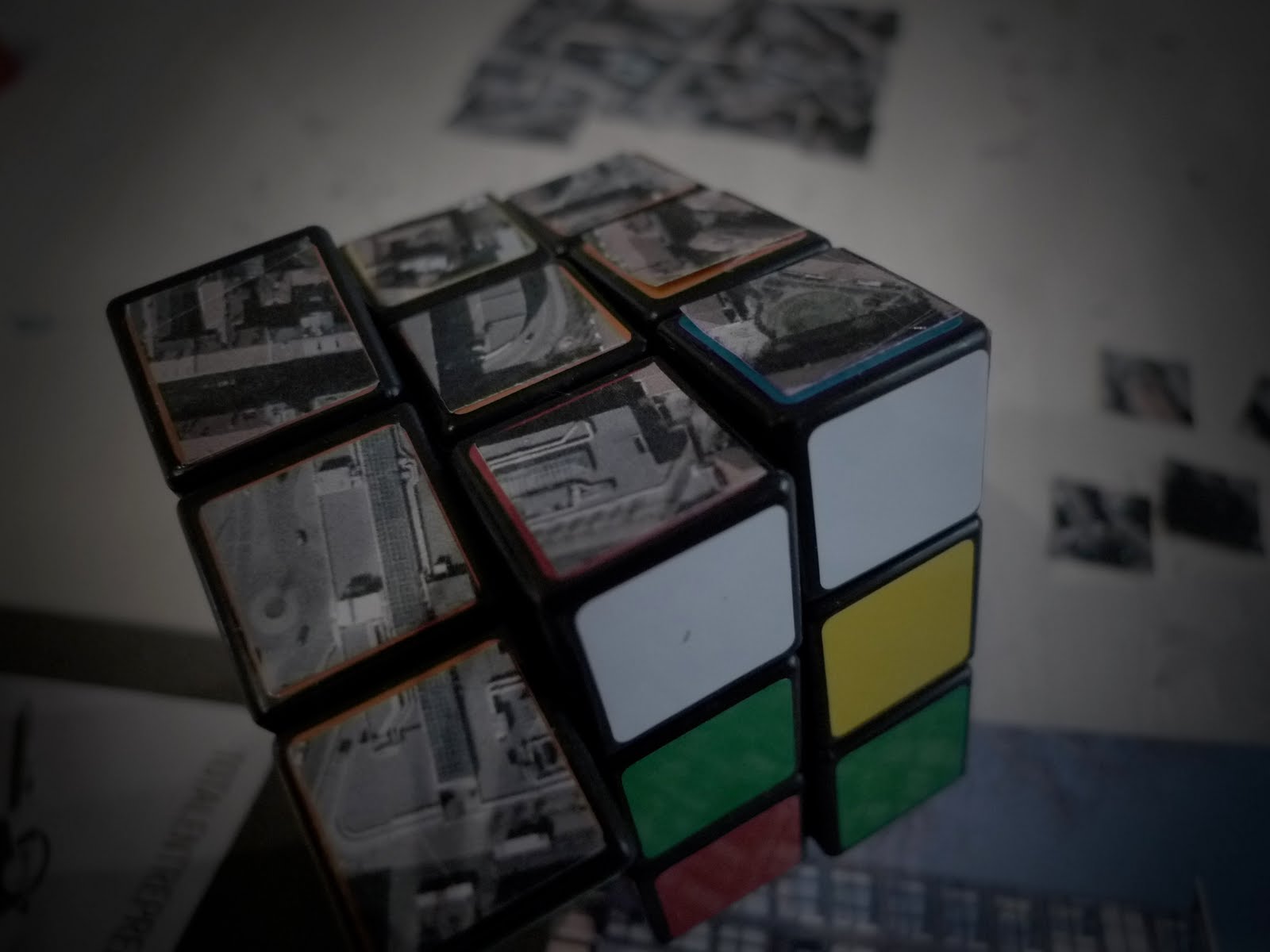
What is a map, what is a photo, through deconstruction of a city scape one makes new ones, combining knowledge with reflection, with emotions, with facts, with recollection etc... made this little rubiks cube last night, the ortophoto is in 1:5000 scale of Grønland, all laid out in the right way, started to twist, to turn, gets to complicated, Ill never get it right, been working all night.

onsdag 14. april 2010

on information


The aphorism "information wants to be free" has become a battle cry of resistance against information controls. A variety of interpretations provide useful insights into what constitutes this "freedom" in the information age. For designers of responsive systems regulating control and freedom in their designs remains a critical problem. How open should a system be? What role should public participation play in its instantion? How does the design engage public space? Who operationally maintains it? Who or what controls it objectives?
How to "free information" without making it just another cliche, how to define whats open and what to stay hidden. Its impossible to free all information, cause it would make our societies collaps, theres allways going to be someone whos just waiting for the right moment to misuse it. Whos to decide this?
In the cities of today it excists a microcosm wich reflects the major challenges and opportunities facing the planet today, only more intensified.
In the city, all man-made systems intersect, interact and interconnect with one another- forming a complex system of systems.

tirsdag 13. april 2010

completition


Architects tend to design a "finished" building that once its completed starts to impair itself. Landscape Architects creates a premise or a process- they design a system, something that starts when they leave it, ie. starts to develop itself on its own terms and thus frees itself from the intended. This can be achived in architecture as well if one emphasized the quality of underspecification. The notion of an architecture as a system with underspecified goals suggests an architecture that evolves and therfore is never complete, like nature itself. This will break down the distinction between a building and its environment; it presupposes that a building creates an environment and carries on creating an environment as it attempts to specify itself.
The architecture then cant help but be ecological in the sense that the input sources and output sources become part of the same architectural system, it reflects the innovation, replenishment and reconstruction. Like landscape architects design with ephemeral materials like plants, wood, water, iron etc, the architect may emphasize the ephemerality of architectural constructions and help counteract the usual architectural obsession with permanence...

søndag 11. april 2010

When ORDER becomes CHAOS


Ive been intrigued by Peter Eisenmans Holocaust memorial in Berlin since I first visited it some years ago. Everytime I go back to Berlin, I allways make sure to find some time to go there and get lost.
What facinates me is the grid, the most rigid structure becomes deconstructed by its own order, the system of the grid becomes chaos in its own simplicity. Something so simple becomes so complicated by playing a game with our inabillity to orientate and percept where we are at any given moment. What seems to be a simple gridstructure is not, in its own entity it beholds a secret complexity.

AESTHETICS


The systems itself and its complexity becomes the aesthetics.