Viser innlegg med etiketten SITE. Vis alle innlegg

tirsdag 8. mars 2011

Bleaching the river...


Akerselva floats through the city, 8.2 kilometers long and with a drop of 149 meters. The river has been the traditional, somewhat simplified border between the east and the west of Oslo, creating an economical and a sosionomical difference between the two parts. It was along this river the industry in Oslo was established and it played an important part in the development of the industrial Oslo.
In the 1970s Akerselva was highly contaminated after 150 years of industrial and sewage discharges along river. In the 1980's, a local program to limit emissions and get the animal and fish life back to river was innitiated. Both the river and the areas along it has taken part in a massive transformation, from a dirty, run-down industrial area to a park and residential area, the transformation was an ecological success.
At the mouth of the river, Oset water treatment plant, owned by Oslo's water and wastewater services, was up and running in 2008 and supplies drinking water to 90 percent of the population in Oslo. Couple of days ago, a leak in one of the tubes containing chlorine was spotted, before it got stopped 6,000 liters of pure chlorine was released into the river. This is the equivalent to 240,000 bottles of regular household bleach. The spill has killed nearly 100% of all aquatic life in Akerselva, so far the observers has spotted only one living fish in the river. NIVA has started investigations to find out how much of the bottom mud is contaminated since this is the most vital part in the ecological system creating the river and thus securing food for the fish. Earlier, contaminated discharges have previously been from the industry in the lower parts, and then the upper parts have been spared, so that have helped the river to recover faster, but now it seems that all parts of the river is infected and it is uncertain when the aquatic life in the river will stabilize. No matter how careful we try to act , accidents do occur…

onsdag 2. mars 2011

an unfamiliar sound


A couple of years ago, the Swiss population determined, by election, to ban the building of minarets on mosques. This decision is highly controversial, meaning that the majority in this case will decide on a minority's right to express both their religion and their cultural heritage through a building design and denying them the right to express themselves in their shared, common public space. Is this a decision which occurs because of irritation over a change of the street space aesthetics or is it racism - different rules for different subcultures in society?
One of the most elaborate new buildings in Grønland is the Islamic Cultural Center Mosque in Åkebergveien.
In 2000, the mosque applied to get the right to call to prayer from loudspeakers outside the mosque. It was met with fierce protests, and it was even formed an action group against prayer. The end of the story was that they were allowed to pray in the framework of 60 decibels. Nevertheless, the mosque chose not to avail themselves of this opportunity and only prayer inside, probably to avoid confrontation (but they probably wouldnt had applied if it wasnt a wish...) At Grønland the senses have a stronger presence than elsewhere in the city. Here the scents are stronger, the colors more present and the sounds more intense than in the rest of the city. These are variables that help to stimulate the curiosity and differentiate streets from each other, these are little hints that tell about what happens but that might not be seen but nevertheless gives a broader expireience of the situation.
It is through these sensory experiences we can experience the city in its entirety, the perceptional account for only a small part of the overall experience, we must not forget the rest of the senses in our understanding of the city.

mandag 7. februar 2011

When snow gets a function


The snowdeposit on Åsland was established in autumn 2006, with paving and drainage, and is the only landfill Samferdselsetaten have in Oslo. When the landfill is full, its been dumped about 250,000 cubic meters of snow here, which is estimated to be about 12 000 truck loads full of snow.
Snow removed from the roads is significantly contaminated by road salt, metals and organic pollutants, but if the landfills are designed appropriately it can reduce the spread of pollutants. The main sources of the contamination is wear of the road, tires, brakes and exhaust. Previously, large amounts of the snow was dumped into the harbor every winter, but because of unwanted litter and growth in the sediments, this was stopped, and the landfill was established instead. The snow that’s been cleared from the streets of the iner city includes both garbage, particles such as sand and gravel, various salts, oil, and not least significant amounts of pollutants. Norwegian Institute for Water Research (NIVA) has estimated that winter 93/94 the snow dumped in the sea added Bispevika (the sea) in Oslo about 1000 tonnes of particulates, 60 kg zinc, 29 kg lead, 20 kg copper, 20 kg chromium, 8 kg PAH and 7.5 tonnes of oil. The snow also contained in the order of 50-190g of the highly hazardous environmental exposure to PCBs.
The massive amount of snow doesn’t melt untill september and may be looked upon as a man made glacier. The transportation of this large amount of snow contributes to a lot of polution from the trucks and also an extra pressure on the road system. In an interlocked local system are there any other ways to solve this?
The content of pollutants in the melted water means it must pass through a treatment plant before it can be released. In the current energy debate it is an important step in making energy use more environmentally friendly. It is important not to forget the cooling demand in this debate. Many commercial buildings and office space has a great need for cooling in summer. At Grønland, a lot of the buildings are solely commercial buildings that’s dependent on heatreducing airconditioning systems, whats the possibillity for the establishment of local snowdeposits which can be connected with the established building mass. A project in Sweden, the hospital of Sundsvall have established such a system; The hospital has a large need for cooling in summer. The air outside are often of 25 degrees, so it is necessary to lower the temperature. This requires a lot of energy in such a large building. This unique project aims to reduce energy consumption, save money and stop all use of freon in the cooling system.

The snow collected from clearing the areas around the hospital, app. 30,000 m3 of snow will be stored on a 7,000 m2 large area. In late April, when theres enough snow, it is covered by wood chips or sawdust. The snow will then be placed under the insulating layer, and slowly begin to melt in May.
The melted water then has a temperature of approx. 1 plus degree and this is pumped through a heat exchanger. Air pumped into the heat exchanger will be reduced to around 20 degrees. After the melted water has passed through the heat exchanger it is sent back to the snowdeposit with a temperature of approx. 15 ° C. The water helps to melt the new snow, which is then pumped back to the hospital again. This cycle continues until all snow has melted.

tirsdag 1. februar 2011

Lets look to Mecca..


New knowledge acquired about the park at Grønland. Vaterlandsparken, made infamous as a drugspot in this millenium was actually intended to surve a higher purpose; the park is located on the so-called mosque site, todays drugspot could have been a place for spiritual meaning and mindtravel in a less chemical way... In the architectural competition for Vaterland in 1982, the city had as a requirement that buildings and axes should relate to the direction towards Mecca that is required for the center axis in any mosque. The Oslo Spectrum and the Raddisson Plaza had to be regulated into this axis. The muslim congregation that pledged to build the mosque at this site later got financial problems and had to abandon the idea and instead we got Vaterlandsparken.

mandag 31. januar 2011

Seasonal occupants/ Follow the leader


When it rains it pours-rephrase that in a nordic manner; When it snows it builds. The police regulations state that the building owners themselves are responsible for keeping the boardwalks clean and free of ice while the city itself is responsible for the streets and walkingzones in the innercity. This mixture of public/private shared responsibillity has given the city a look which at best can be described as a quilted blanket, the minimizing of walkable areas caused by the power of nature is acting as the biggest occupant of public space but at the same time it is still acting as a live tracer; the routes people take and the decissions they take on theire way through the cityscape leaves a walked impression of the choiches beeing made, or, does it mean that the first person who walks through the streets after heavy snow makes decissions for everybody else to follow the next couple of days, ha, what made him a leader.

Enough is never enough..


Approximetly two years ago, chief of police; Arnstein Gjengedal promised the public to keep the streets of Grønland drug free, or as he stated; Enough is Enough! Like all other daring statements its a failure, or as I stated myself on this blog half a year ago; a user is a user 365,24/7. In a city there will allways be secret transactions and secret locations for doing illegal bizz, the only thing we can change about this is the way we regard this, if we chase these people away from a known locality theyll just find a new place for theire activities tomorrow. Whats bugging me about this is not the dealing of illegal substances, nor the appearence of the buyers/ users but, the media plays a big role in portraying the reallity of a neighbourhood; the constant focus on the problems instead of having a discussion around solutions. This link is from yesterdays aftenposten and is about the war on drugs at Grønland. Last year 737 persons where comprehended, half of them more than once. One out of two has either been rejected as an asylant or is living here without proper permit. 136 of them is enrolled as asylants, and for the rest, the story goes on…
According to the police; people from Algeria, Nigeria and Somalia are in the top three ranking of the arrests, these three countries are among the worst on the UNs list of Living Conditions (Somalia is not even on the list due to lack of data..).
Last year, the police expelled 189 of the arrested people in this neighbourhood back to theire country of origin. The questions that should arise then is not if these people are criminals or not, (of course they are when they have broken the laws), but what we should question is rather WHY they are there, on the streets, pushing dope under the bridge. There is a reason for everything but whats the reason for the constant witchhunt on the users and buyers and the will that some journalists have in making Grønland appear more dangerous than it really is? I know that rain sells better than sunshine, lets not hope that this also accounts for stigmatization…

mandag 24. januar 2011

POLAR BEARS DONT HIBERNATE


Hibernating means to pass the winter in a dormant or lethargic state. Animals that hibernate store body fat when food is plentiful. When food is scarce, they hibernate, living off their stored body fat.
Polar bears do not overwinter in dens like brown and black bears. Hibernation in the true sense of the word does not apply to polar bears.

Only pregnant females enter dens to give birth where they stay until the cubs are big enough to trek.
To build her den, the female scrapes a tunnel into the snow and digs two chambers, this technique is closely related to the igloos of the eskimoes, a shelter constructed out of snow to give protection from the snow, this is the ingenious part of it, turning a negative factor into a protective one.
Most polar bears remain active throughout the year.
They have the ability to reduce their metabolic rate when food is scarce and adjust it again when food is abundant.
Male and non-pregnant female polar bears do not hibernate, but can switch over to a "Walking Hibernation" when there is not enough food.
They slightly lower their body temperature and decreased heart and breathing rates.
This physiological act is unique to Polar Bears no other bear can do leaving the polarregion as a new Transilvania full of walking deads,
i.e. the zombie bears.
Since I have been gone for so long in a hibernating state its now time to get back in the game and do as the polar bear, lower my bodytemperature a little bit and start hunting in the streets of Grønland for scraps and hidden tales, so, now its on again.
All this talk about polar bears, hibernation and igloos leads me to my next point;
The climate outside this time of year is quite different then what it was when I started my Grønland project and I will use the next couple of days to examine the effects of snow, low temperature and the difference in tempo that applies to these seasonal changes in the cityscapes.

lørdag 22. mai 2010

expanding the business


Some parts of the city are more reluctant to have both a shift in appearence and tempo on the street. This must be said to be the fact for Grønland, here, more than any other place in the city, smalltime vendors tend to break the building envelope and decrease the barriers between private/ public through expantion of their businesses from inside the shops to the street. This unregulated use of public space may be looked upon as a commercialization of public areas (the streets should be a free space etc...) ,but, in this case I prefer to look at it as something that helps the streets to stay bizzy and vibrant, through this push/pull the shopowners contributes in giving the streets a constant reapperance. The actual use of space far exceeds the citycouncils regulated/designated use of the streets and contributes in keeping the city alive.

torsdag 20. mai 2010

sleeping places


In a cityscape, the secret getaways becomes important, this is the places where the "non-people" sleep, eat and live theire lives, under the bridge, in an abandoned building, between the roads and under the trees. Seeked out a few of these places and checked out the living conditions for these unwanted members of society...

The Playgrounds


Went around yesterday, made a mapping of the children spots, ie. kindergardens, playgrounds, park areas, footbal fields, "mystery" places etc..
What really hit me is not the lack of organized, planned places for kids to play, but, the area is full of hidden gems, small getaway places where the kids can hide, construct theire own reality and play alone and without interruption. Some would call this an hazardous freedom, but for these kids that are used to this area and its norms, its an adventureus world...

Shifting Appearance


In connection with the celebration of 17.th of may, the whole of the Vaterland Parc went from beeing a drugspot to become an explosion of vivid colours, sounds, movements and joy. The tivoli came to town, an example of intervention through activity, presence and new buildings added to the site, introduction of a new program that totally changed the area. When the tivoli left two days later, the disorder re-established itself and everything went back to normal, the junkies found their old spot, the sellers theire costumers, the beggars theire patrons etc...

mandag 10. mai 2010

MAPPING VISUAL ADD-ONS


Started a new way to map the visual add-ons to the buildings in the area. Is there a connection between visuall add-ons (commercial signs, roadsigns, graffiti etc..) and tempo, temporality, action, etc...
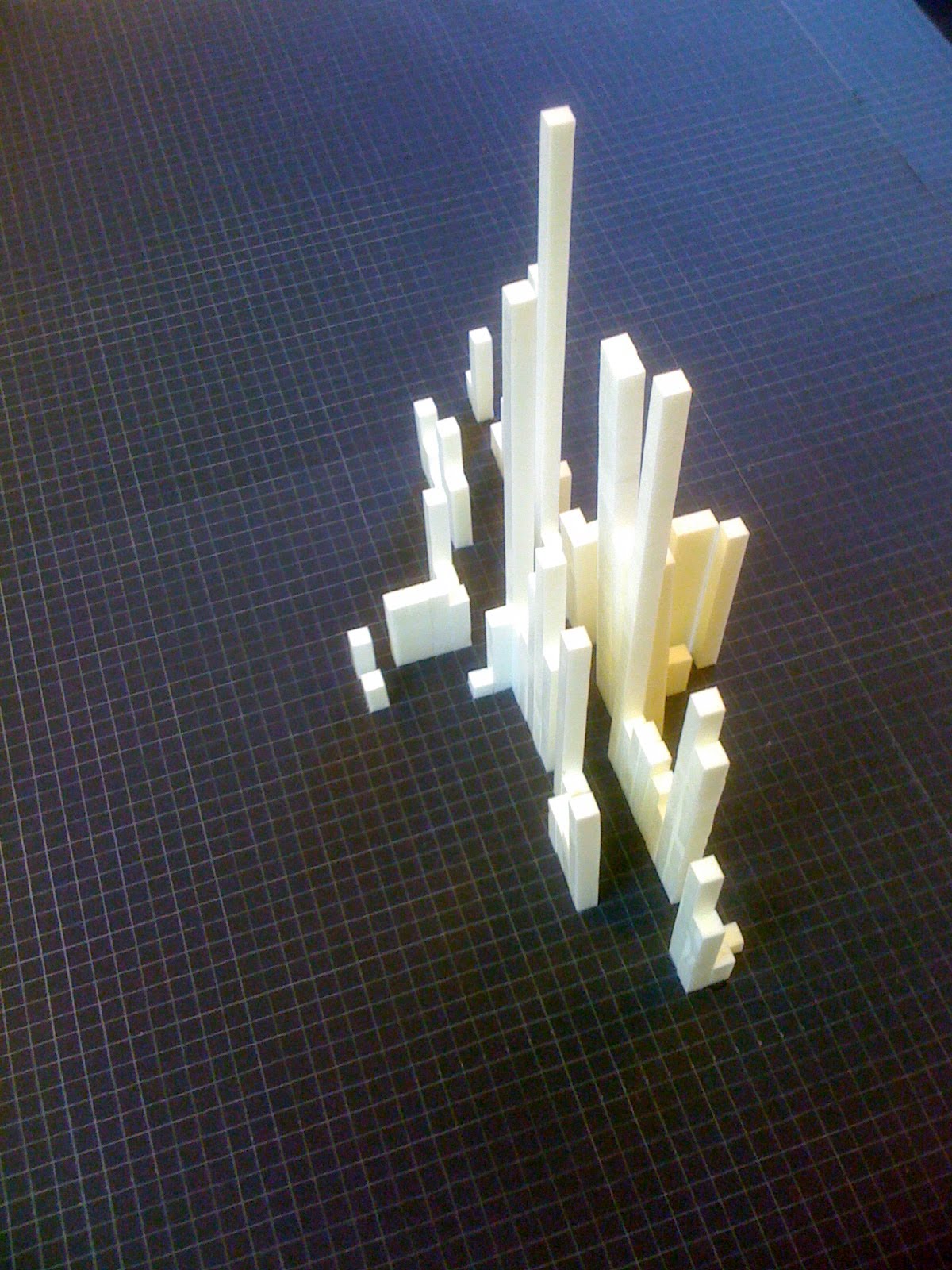
A grid 1x1 cm is put on top of the 1:1000 map, each facade is thouroughly examined. The first column makes up the shopowners/buildingowners add-ons to the existing facade. This is put up in order to gain attention and costumers, the rule seems to be that the one that screams highest gets the cash. The actual number of signs makes up the hight of the column, one cm pr. sign. Secondly, the column shows the number of "official signs, i.e. the ones that shows important information regarding the actual use of the area, the rules etc., this is another layer of information and is put up with no other aim than to secure a well-functioning society/infrastructure. The third column on top shows the actual number of tags/graffiti on the building facades. These are made by people that seemingly has no right to the facade, its an individuals intervention on private owned buildings and this defragmentizes the boundaries between public/private. This is also connected to the broken window theories, can I through an abstract presentation of this data see more clues to how this relates to our interpretation of the cityscape?

torsdag 6. mai 2010

OPEN/CLOSED


Oslo Prison is the biggest prison in Norway with 392 prisoners and 367 employees.
The prison opened its gates for its guests in 1844 and is built accordingly to the "Philadelphia System" which meant that the prisoners were isolated in solitary confinement. Nowadays this has changed dramatically and the system now operates with a totally different approach; "There is a greater tendency to keep prisons open [to the public] so that people can see inmates as human beings they can identify with," says Nils Christie, professor of criminology from the University of Oslo. Nowadays the government emphasize on seeing prisons as part of normal society and the need for reintegration into society rather than the need for punishment.
With such a massive building in such a central place, and the fact that out of Grønlands population wich makes up 7788 inhabitants, the inmates makes up around 5% of the total population (not sure if they are included in the counts or not, but, they are allowed to vote and they do live and have their adress there...) Every once in a while the prison opens its doors for the public- so called open prison days- and try with events like this to be a part of the neighbourhood. The prison is seperated from the area with a huge wall, even though the distance seems short the gap is long. In front of the prison is the most public area of Grønland and the only open recreational area, the park where people sunbathe and have barbeques in the summertime. This makes an interesting juxtaposition between the closed and the open.
The Guardian-article about political prison debate
Oslo Kretsfengsel

søndag 2. mai 2010

property


The discussions around property are one of the most ambivalent in todays media.
Throughout history, mankind have used property as a hierarchical tool in controll of the masses-this is mine-not yours, stay in your place etc..
Traditional principles of property rights include:

1. control of the use of the property.
2. the right to any benefit from the property.
3. a right to transfer or sell the property.
4. a right to exclude others from the property.

Traditional property rights do not include:

1. uses that unreasonably interfere with the property rights of another private party.
2. uses that unreasonably interfere with public property rights, including uses that interfere with public health, safety, peace or convenience
Property
Intellectual Property

With the technology of today the discussion is quite different, once something is digitalized it doesnt make sense to claim proprietary ownership of it-IT´S A COPY.
In the FLOSS system, it is a given fact that property is theft, you can only own the background content, i.e. the code, not the "final" product because this is everchanging, the traditional order and the barrier between product and byproduct is torn down.
In order to allow for invention, the traditional claim of the property must be revitalized, like a remixed tune, the "thief" becomes the developer.
How to deal with this in a city where the boundaries between yours and mine are the glue that holds the society together, that differentiates people and make them care for their surroundings. Are there any clues on the street, the interaction, that can inform us of another way of thinking? At Grønland, the idea of a controlled ownership seems to be less abundant than in the rest of the city, could this be because of the tempo, the compactness of people on the street and in the fact that people are more tolerant, the ephemerality is more visible, are the facades of the buildings and the air in this part of town more public here because of this? It seems at least that the traditional property view is less of an issue here than other places.

lørdag 1. mai 2010

ZOOMaSHROOM


mapping the intricacy on Grønland at the moment. The more I seek, the more ill find, whats relevant, whats not, is it all?

torsdag 29. april 2010

POWER STRUCTURE


Two of the most feared public buildings in the city are located at Grønland. The Prison of Oslo and the Police Headquarters, in the first you end up if you fuck up, in the latter you end up if you fuck up a little. (Prison vs. Arrest.) They are out of touch with the sphere they coexist with, the scale is to big and they create a distance to the rest of the area, becoming isolated islands of power. The authorities will allways have this need of showing off the structures of power, but, in this case the distance tend to get a litle bit too much.
What are the implications regarding the governments negative charachter, when the authorities distance itself so strongly from the rest of the neighbourhood? The amount of money spent on police increases each year, the proximity wich comes with police foot-patrols gets decreased each year. Result; the broken window theory, mistrust towards the power, mistrust towards the ones that are their to secure equal right to society.

onsdag 28. april 2010

THERES A JUNKIE IN EVERY TOWN


the stash of hash...
Mr. Harry Jones...
need for speed...
the thrill of the pill...


After working at Grønland at a bar for quite some time I have made some interesting encounters with strangers, people I really dont wanna be friends with but at the same time needed to hook up with in order to see ”the secret societies”.

Last monday I hooked up with ”Mike”, a local heroin dealer, pushing at street level.
Mike is an infamous character working at Vaterland, one of the main spots for the heroin trade in Oslo.
Mike wanted to show me how the drugtrade worked and agreed to help me score some dope. Within the short period of an hour we bought heroin, amphetamine, funky blue pills and some hash. Due to implications on the criminal consequences, Mike was bying the dope while I was witnessing.
It was an interesting experience, now I got the first hand information I need in order to map this part of the chaos. Prices do vary, for a user dose of heroin the price was 250, amphetamine set us back a 100, the pills were 20 each and the hash was 100 a gram. The hard drugs was bought at Vaterland from a white dealer, while the hash was bought from illegal african immigrants innside the metrostation at Grønland.
Later we tried to score some khat but the somalies dealing the drug Grønlandstorget was suspicious towards non-somalians bying the drug, so the idea of bying this got abolished. I left ”Mike” with the drugs for him to enjoy alone, heading back to Bergen. Will hook up with him again and talk more about the trade, the the dealers and the customers when I return to Oslo for the second part of the analysis.
Even though the police do their best to stop this and interupte this type of affairs it was extremely easy to get the stash we wanted. A junkie is a junkie 365-24/7 so the business is never closed.
No matter what you think of drugs, I like the idea of a selfsustainable economy operating within its own context and by its own complex system.
NIVAs surveys from the water treatment plants in Oslo in 2007 indicates 15 cocaine doses per 1000 inhabitants per day. This gives us 8700 doses of cocaine in Oslo snorted up the nose every day. Cocaine addicts stand out from the users of heroin and amphetamines due to the fact that they often only use the stuff in the context of a party (some party everyday…). For the users of heroin the party is definitely over. It is estimated that between 8,200 and 12,500 inhabitants in Oslo is addicted to heroin and amphetamine and their injection of the drugs is extremely harmful to health.
An average user of heroin need on average 760 NOK a day to meet their as an amphetamine user can operate on 290 NOK. (Figures from SIRUS 2004)
- We are at Grønland metro station daily and arrest people. Steadily. Every day, all year round, 365 days a year, we arrest ten people in our circle of drug crime, "says Stølen, chief of police at Grønland Police Station.

tirsdag 20. april 2010

ROOFTOP JUNK


a mapping of the GSM(red),NMTM(yellow) mobile phone towers in the area. These towers are a part of the new infrastructure called SSC-sensor, software, connectivity, and shows how this structure build a new layer on top of the "traditional" infrastructure, WGE-water, gas, electricity, in the city. SSC is designed to excist in the background, blend in with other rooftop junk and its signal is only readable through another device, i.e the mobilephone. This means that its signals are meaningless without a way to ACCESS them, in this case the phone becomes the KEY or the CODE to understand the rooftop installations.

criminal city


Mapping the criminal use of the city by examining the police reports. Some of the information, like stick-ups are site specific (down to the exact spot) while other data (like violence) are more general, only showing the zones where the violence is most agressive. I will further into this and try to make it even more specific. WHY is this relevant? Maps like this makes transparent something that absolutely shapes both the affective experience of being in the city and the choices we make there-the actuality of street crime-and by plotting these reported incidents an a map we visualize the exact knowledge. What if this information was ambient- that the information came to you while you where in that place? Sensing this through walking in the street, would one feel different when one had the exact INFORMATION, NOT just ASSUMPTIONS on the conditions on the crime/ dangers on the street?

income


The average salary in Norway was according to SSB 410.400 NOK (2008)
The average income in Urtegata, one of the streets at Grønland was 86.000 NOK, the lowest average income in all of Norway. People rely on social assistance, in 2004 one out of every fifth NOK on the governments social budget was used in Oslo. In the inner city, 8.5% are considered poor. There are also great differences within the city and also a great variation within each boroughThere are significant differences in median income for households between districts in Oslo. For all types of household income is generally higher in the western parts than in the eastern parts. The differences are especially for people living alone and the highest for couples with children 0-17 years and households with older children. For example, the average couple with children 0-17 years, is almost twice as high in the borough Vinderen (691.700 NOK) compared to Gamle Oslo (350.800 NOK). So, what does this really tells us; differnces are everywhere, on every scale, within every building...